It may surprise some that our proposals embrace what is commonly referred to as degrowth – the attempt to reduce overall material and energy flows while equitably safeguarding livelihoods. Why do we call for an end to growth when nearly every political leader is calling, often vacuously, for more growth?
With the new Labour government centering its whole approach on the pursuit of the increasingly elusive GDP growth, it is timely to present the counter-argument.
The following text is reproduced from our main report – the references cited can be found in that report.
The problem
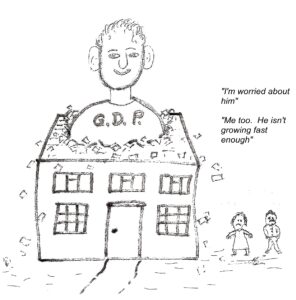
The way our economy is organised at present is unviable because it depends on endlessly growing in size to sustain itself and maintain a semblance of social stability. This growth, at a preferred three percent per year, is regarded as exponential, growing like compound interest. Three per cent per year would mean an economy that doubles in size every 27 years or increases eight-fold in an average Western lifetime. It is not surprising that critics of economic growth liken it to the pathological growth of a tumour, rather than healthy growth that reaches a natural limit.
This requirement for infinite growth is ecologically unviable: there is no evidence that it is possible for economic activity to be separated (decoupled) from the amount of energy and physical material moving through the global economy (Burton, 2016; Haberl et al., 2020; Parrique, et al., 2019; Schandl et al., 2016; Wiedenhofer et al., 2020; Wiedmann et al., 2015). It is therefore incompatible with the finite nature of the planet and the environmental resources which support human life, depending on the destruction of ecological abundance and the capture of value from regions of the majority world (Hickel, Dorninger, et al., 2022; Smith, 2012).
A further problem is that growth in the material economy, while often seen as necessary in order to alleviate poverty, has in recent times led to the concentration of wealth and thereby to increasing inequality (Roberts, 2017; Tcherneva, 2015; Woodward, 2015).
Apart from this ‘diseconomics of growth’ (Hodson, 1972), it is in any case questionable whether the continued expansion of the economy can be achieved and sustained. The phenomenon of ‘secular stagnation’, an inherent reduction of the capacity of the economies of the rich countries to grow, has been well documented in both the mainstream and the critical economics literature (Streeck, 2016; Summers, 2016). This has to do with the exhaustion of the sources of capitalist expansion, such as cheap labour sources, cheap energy and materials, limits to technical innovation and new markets, as well as the increased propensity of the ecosystem to ‘bite back’, for example through climatic shocks impacting on food production. If neither neoliberal nor Keynesian prescriptions can force growth at the level the mainstream consensus believes desirable, isn’t it time to abandon the aim and instead try another approach (Jackson, 2019)?
A viable alternative
An economy that is ecologically, socially, and indeed economically viable requires re-design to ensure economic activity is based on what is socially useful while restoring and maintaining ecological assets. The fudges of ‘good growth’ and ‘green growth’ are not sufficient; the viable economy (Burton et al., 2020) is only ecologically viable when it is able to function without growing in overall size. In fact, it is necessary to actually shrink the material flows of energy and resources flowing through the global economy, and that means shrinkage of its scale here in the UK too1.
The viable, degrowth, alternative is socially preferable. Real increases in productivity and technological improvements must be better shared as real improvements in quality of life. This includes reductions in working time and increasing opportunities to undertake activities that need not make a profit but have value for individuals and communities. Ecological economists have modelled these policy choices under post-growth scenarios and conclude that they are feasible (Jackson & Victor, 2016; Lange, 2018; Nieto et al., 2020; Victor, 2019).
-
1 This refers to the material scale of the economy which is not necessarily the same as the scale of its monetary value, although as can be seen from the decoupling literature referred to above, the two are usually very closely linked.